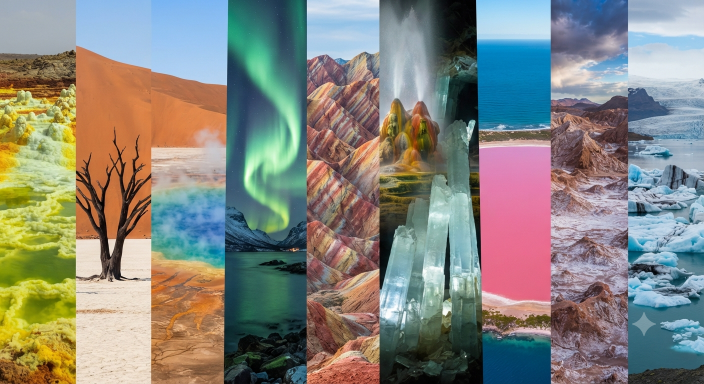
Nature is full of surprises, but some places on Earth are so unusual that they almost seem impossible. From lakes that change colours and beaches that glow at night to deserts covered in mysterious patterns, our planet has countless natural wonders that challenge our imagination. These extraordinary locations are not the result of magic or science fiction. They are created by natural processes involving minerals, microorganisms, weather conditions, volcanic activity, and unique geographical features. Whether you love adventure, photography, or fascinating scientific discoveries, these ten places offer a glimpse into some of the strangest ways nature behaves.
1. Lake Hillier, Australia – The Naturally Pink Lake
Lake Hillier in Western Australia is famous for its striking pink colour. Unlike ordinary lakes, its water has a bubblegum-pink appearance that creates a dramatic contrast with the surrounding green vegetation and blue ocean.
The unusual colour is associated with salt-loving microorganisms, including certain algae and bacteria. The lake’s high salt concentration creates an environment where these organisms can thrive.
One of the most fascinating features is that the lake retains its distinctive pink appearance even when water is collected in a container.
2. Salar de Uyuni, Bolivia – The World’s Largest Natural Mirror
Salar de Uyuni is the world’s largest salt flat and one of the most extraordinary landscapes on Earth.
During the rainy season, a thin layer of water covers the salt surface and creates a perfect reflection of the sky. The horizon almost disappears, making visitors feel as though they are walking through the clouds.
This incredible mirror effect attracts photographers and travellers from around the world. During the dry season, the area transforms into a vast white landscape covered with geometric salt patterns.
3. Fly Geyser, Nevada, USA – A Colourful Natural Fountain
Fly Geyser in Nevada looks like something from another planet. Its colourful formations rise from the desert floor, releasing naturally heated water into the surrounding environment.
Interestingly, the geyser’s formation is connected to human activity. A geothermal well drilled in the area in the early twentieth century contributed to the development of the unusual structure.
Mineral deposits and heat-loving microorganisms create its bright orange, green, and reddish colours. It is a remarkable example of how natural processes and human activity can combine to create unusual landscapes.
4. Waitomo Glowworm Caves, New Zealand – A Starry Underground World
The Waitomo Glowworm Caves are famous for their magical-looking blue lights. Thousands of tiny glowworms illuminate the cave ceilings, creating an appearance similar to a star-filled night sky.
These glowworms produce light through a biological process called bioluminescence. The glowing light helps them attract insects, which become trapped in sticky silk threads hanging from their bodies.
Visitors can explore the caves through guided boat tours and experience this extraordinary natural display.
5. Lake Natron, Tanzania – A Highly Alkaline Lake
Lake Natron is known for its reddish appearance, high alkalinity, and extreme water conditions.
The lake contains large concentrations of minerals and salts, creating an environment that is unsuitable for many animals. However, certain microorganisms thrive in these conditions and contribute to its unusual colours.
Despite its harsh environment, Lake Natron is an important breeding ground for lesser flamingos, making it an extraordinary example of wildlife adapting to challenging conditions.
6. The Door to Hell, Turkmenistan – A Burning Desert Crater
The Darvaza Gas Crater, popularly known as the Door to Hell, is one of the strangest sights in the Karakum Desert.
This enormous crater has been burning for decades, producing flames that glow brightly against the dark desert sky.
Its origins are linked to a Soviet-era drilling operation that caused the ground to collapse into an underground natural gas cavity. The gas was reportedly ignited to prevent its spread, but the fire continued burning.
The glowing crater has become one of Turkmenistan’s most unusual attractions.
7. The Blood Falls, Antarctica – A Red Waterfall in the Ice
Blood Falls is a striking red waterfall flowing from the Taylor Glacier in Antarctica.
Its colour is caused by iron-rich salty water. When this water reaches the surface and comes into contact with oxygen, the iron oxidises and produces a reddish appearance, similar to rust.
Scientists have also discovered microbial life in the salty water beneath the glacier, making the location particularly interesting for research into life in extreme environments.
8. The Sailing Stones of Death Valley, USA – Rocks That Seem to Move Alone
For many years, visitors to Racetrack Playa in Death Valley noticed rocks leaving long trails across the dry lakebed.
The rocks appeared to move without anyone pushing them, creating a mystery that attracted scientific attention.
Researchers eventually discovered that thin sheets of ice, combined with light winds, can push the rocks across the wet surface.
This unusual combination of conditions explains one of nature’s most fascinating geological mysteries.
9. Socotra Island, Yemen – A Landscape from Another Planet
Socotra Island is famous for its unusual plants and isolated ecosystem. Some of its most recognisable trees are dragon’s blood trees, which have umbrella-shaped branches and produce distinctive red resin.
Because of its long geographical isolation, the island has developed a remarkable collection of endemic plant species.
Its unusual landscape looks almost alien, making Socotra one of the most visually distinctive places on Earth.
10. The Grand Prismatic Spring, USA – A Rainbow-Coloured Hot Spring
Located in Yellowstone National Park, the Grand Prismatic Spring is famous for its brilliant rings of colour.
Its centre appears deep blue, while the surrounding areas display shades of green, yellow, orange, and red.
These colours are produced largely by heat-loving microorganisms that thrive at different temperatures around the spring. The mineral-rich water and geothermal activity make it one of the most spectacular natural attractions in the United States.